

Digital Arrest Scam in India: How to Stay Protected in 2026

If you have received a call saying your Aadhaar, SIM card, parcel, bank account, or PAN is linked to a crime, it is natural to panic. Many people in Bengaluru and across India freeze when the caller claims to be from the police, CBI, ED, Customs, RBI, or a cyber cell. Here is the direct answer: a digital arrest scam in India is not a real arrest under Indian law. No police officer, court, or government agency can legally arrest you on a WhatsApp call, keep you under video surveillance for hours, or demand money to stop arrest.
What these fraudsters do is use fear, shame, and urgency to control you. The Government of India’s cybercrime portal has also published an official advisory on digital arrest scams. Indian law has clear rules on how arrest, interrogation, notice, and investigation work. This article explains what digital arrest is, how a real cybercrime arrest in India actually happens, the warning signs you should know, the immediate steps to take, and the legal remedies available if you have already paid money or shared personal details. If you want a broader background first, you can also read our guide to Indian criminal law and process basics.
Why a digital arrest scam in India has no legal basis
A fake digital arrest sounds official, but the legal process of arrest in India does not work this way at all.

Many people ask, ” What is digital arrest? In plain language, it is a scam in which fraudsters pretend to be officials and claim you are under investigation or arrest. They may say a parcel with drugs was sent in your name, your Aadhaar was used for money laundering, or your mobile number is linked to criminal activity. Then they pressure you into staying on a call, sharing private details, or sending money for “verification”, “clearance”, or a “security deposit”. Our detailed guide to drug possession charges under the NDPS Act explains this further.
That is not a lawful arrest.
A real arrest in India is governed by the Bharatiya Nagarik Suraksha Sanhita, 2023. If a person is arrested, the law requires proper procedure, including disclosure of the grounds of arrest, communication of bail rights in appropriate cases, information to a relative or friend, and production before the proper authority within the legal time limit. You also have the right to meet an advocate during interrogation. Our detailed guide on your rights when arrested in India explains these safeguards in simple terms.
A genuine agency may contact you, issue a notice, summon you, or ask you to appear. If you are confused about a police notice, read our guide on a Section 35 BNSS police notice. But it will not do any of the following to create a lawful arrest:
- Arrest you by video call
- Ask you to stay isolated from family or a lawyer
- Demand immediate payment to avoid jail
- Ask you to move money into a so-called safe account
- Ask for OTPs, UPI PINs, passwords, or full banking access
How scammers create fear and force quick decisions
These scams work because they make you believe that delay will ruin your life, reputation, job, passport, or family peace.
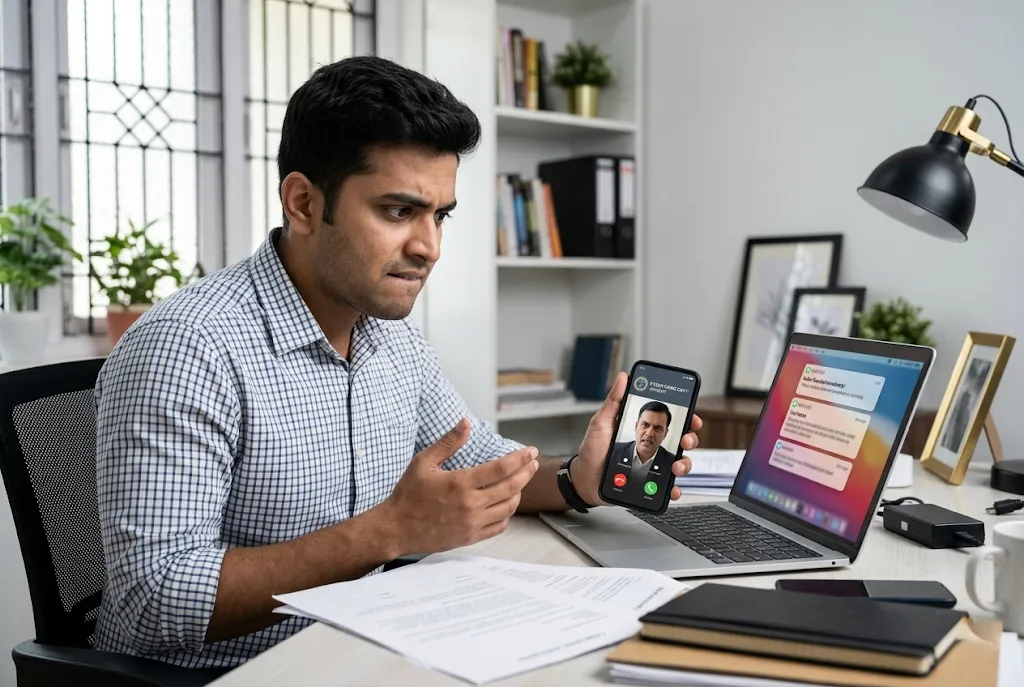
The pattern is now very common. First, you receive a call, often from a spoofed number or a WhatsApp account with a police or government logo. The caller sounds confident and uses your basic personal details to appear credible. Then comes the allegation: illegal parcel, money laundering, drug case, fake SIM, suspicious bank account, obscene content, tax issue, or terror funding.
After that, the pressure rises quickly. The caller may transfer you to a fake “senior officer”, show forged ID cards or fake court papers, ask you to switch on video, and order you not to speak to anyone. In many cases, the victim is told that speaking to family, colleagues, or a lawyer will amount to interfering with an investigation.
Common red flags include:
- Threats of immediate arrest without proper notice or procedure
- Repeated demands for secrecy
- Pressure to stay on a continuous audio or video call
- Fake documents, stamps, IDs, or arrest warrants sent on WhatsApp or email
- Demands for money to “verify”, “settle”, “freeze”, or “clear” your name
- Requests for Aadhaar, PAN, bank details, OTPs, or screen-sharing access
How a real cybercrime arrest in India actually works
The best protection against panic is knowing what the real legal process looks like.
If there is a genuine criminal inquiry, the authorities follow procedure. Depending on the facts, a person may receive a notice, a summons, or a direction to appear before the investigating agency. In some cases, police can arrest without a warrant, but that too must follow the statutory process under the BNSS. The officer must identify himself, communicate the grounds of arrest, prepare the necessary arrest documentation, and inform the arrested person of important rights. The law also requires information about the arrest to be given to a relative, friend, or nominated person.
So if someone tells you that a cybercrime arrest in India can happen entirely on a video call and be avoided by sending money, that is a major warning sign. Real investigation is procedural. Scam pressure is theatrical.
The main laws that usually apply in digital arrest cases
These cases are not about one special “digital arrest law”. They are usually prosecuted under ordinary cheating, extortion, intimidation, and cybercrime provisions.
| Law | Provision | Why it matters |
| Bharatiya Nyaya Sanhita, 2023 | Section 318 | Cheating by deception |
| Bharatiya Nyaya Sanhita, 2023 | Section 319 | Cheating by personation |
| Bharatiya Nyaya Sanhita, 2023 | Section 308 | Extortion, including threats to obtain money |
| Bharatiya Nyaya Sanhita, 2023 | Section 351 | Criminal intimidation |
| Information Technology Act, 2000 | Section 66C | Identity theft using digital identifiers |
| Information Technology Act, 2000 | Section 66D | Cheating by personation using a computer resource or communication device |
In practice, police may add other provisions depending on how the fraud was carried out, whether forged documents were used, whether accounts were mule accounts, and whether multiple accused were involved.
Practical steps: What to do if you receive a digital arrest call
The first few minutes matter most. Your goal is to break the scammer’s control before fear turns into compliance.

Follow this checklist in order:
- End the call. Do not continue the conversation to “clear your name”. A scam gets stronger the longer you stay engaged.
- Do not transfer money. No fine, bond, safe account, verification deposit, or temporary freeze payment is part of a lawful arrest procedure.
- Do not share sensitive data. Do not give OTPs, card details, CVV, UPI PIN, passwords, Aadhaar images, PAN copies, or screen-sharing access.
- Verify independently. Look up the official number of the police station, agency, or court from its own website and call yourself.
- Preserve evidence. Save call logs, numbers, screenshots, WhatsApp chats, emails, fake notices, payment requests, and transaction details.
- Tell one trusted person immediately. Scamsters isolate you for a reason. Breaking secrecy often breaks the scam.
- Report the suspect. Use the National Cyber Crime Reporting Portal and the Report Suspect to I4C tool, especially if you have not yet lost money.
- If money is at risk, act within minutes. Contact your bank, block cards or UPI where needed, and call 1930 without delay.
If you are in Bengaluru, you can also approach the nearest cybercrime police unit or local police station with the evidence you preserved. If the fraud attempt came through a suspicious call, SMS, or WhatsApp message and you have not yet lost money, you can also use Chakshu on Sanchar Saathi to report suspected fraud communication. Our step-by-step guide on how to file a cybercrime complaint in Karnataka can help you organise the process.
What to do if you have already paid money or shared documents
Even if you made one transfer or sent one document, do not assume the situation is hopeless. Fast action can still help.
Take these steps immediately:
- Call 1930 and report the fraud
- File a complaint on cybercrime.gov.in
- Inform your bank or payment app in writing and through customer care
- Ask the bank to block further debits, flag beneficiary accounts, and note the fraud complaint number
- Change internet banking, email, and app passwords
- Disable or reset UPI where necessary
- Block cards and review standing mandates or linked apps
- File a police complaint or FIR with all available evidence, and review our guide on filing an FIR in India if you are unsure where to begin
If you shared Aadhaar, PAN, or account details but did not pay money, you should still report the incident. Identity data can be misused later for fake accounts, fraudulent SIM activation, loan applications, or further impersonation.
Can the bank reverse the loss?
Bank recovery is possible in some cases, but it depends heavily on speed, transaction trail, and the exact way the money moved.
Under RBI customer protection directions on unauthorised electronic transactions, banks must provide 24×7 reporting channels and take immediate steps once a customer reports a suspicious or unauthorised transaction. However, digital arrest cases are tricky because victims often transfer money themselves under fear and deception. That means zero liability is not automatic in every case.
Still, you should report immediately. If your bank does not respond properly or there is a clear service deficiency, the RBI Integrated Ombudsman Scheme may also become relevant after the bank has had an opportunity to resolve the complaint. If the threat appears genuine and you are worried about arrest in a real criminal case, it also helps to understand bail laws in India under the BNSS at the earliest stage. Quick reporting can help trigger internal fraud response, beneficiary tracing, freezing requests, and escalation. Delay helps the fraudster layer or withdraw the money. That is why the first hour is often critical.
Why early legal advice from Kapil Dixit LLP matters in these cases
Good legal advice is not just about filing papers. It is about taking the right steps in the right order while the money trail and evidence are still alive.

In digital arrest cases, a lawyer can help you review the facts calmly, organise evidence properly, assess which criminal provisions apply, guide complaint drafting, and push the matter in the correct forum. Where needed, legal counsel can also help with follow-up representations, bank correspondence, complaint escalation, and strategy if identity misuse continues after the first incident.
At Kapil Dixit LLP, our criminal lawyers in Bangalore combine practical courtroom understanding with a grounded awareness of how cyber-enabled fraud works in real life. For clients in Bengaluru and across Karnataka, early legal support can reduce confusion, avoid mistakes, and improve the quality of the record you place before the police, bank, and other authorities.
FAQs about digital arrest scams in India
Is digital arrest a real concept under Indian law?
No. There is no legal process called digital arrest under Indian law. Fraudsters use that phrase to scare people into obeying illegal demands. A real arrest must follow the criminal procedure laid down by law.
Can police arrest me over a WhatsApp or video call?
No police officer can lawfully complete an arrest simply through a WhatsApp or video call. An officer may contact you and ask you to appear or cooperate, but that is different from arrest. If the caller is demanding money or secrecy, treat it as a serious red flag.
What should I do if the caller knows my Aadhaar or PAN details?
Do not assume the call is genuine just because the caller has some personal information. Data leaks, old documents, public records, and prior scams can expose basic details. End the call, preserve the evidence, and report the incident quickly.
I transferred money because I was scared. Have I done something illegal?
Usually, a victim who transferred money under deception is not the offender. The immediate issue is protecting your accounts, reporting the fraud, and creating a clear record of coercion and impersonation. Do not hide it out of embarrassment; fast reporting matters more than perfect judgment.
Can I recover the money if I report the scam late?
Recovery becomes harder with delay, but it is still worth reporting. Even if the money has moved, the complaint helps with investigation, account tracing, and future action. Late reporting is better than no reporting at all.
Do I need to file a police complaint if I did not lose money?
In many cases, yes, at least report the incident through the cybercrime portal or suspect reporting tools. A failed attempt today can become identity misuse tomorrow. Reporting early also helps authorities identify repeated numbers, accounts, and patterns.
Why do scammers ask me not to tell my family or lawyer?
Because isolation is part of the fraud. Once you speak to a family member, friend, or lawyer, the scam often falls apart. Secrecy is not a legal requirement in normal arrest procedure; it is a psychological control tactic.
Can fake notices, warrants, or court papers sent on WhatsApp be trusted?
Not by themselves. Any such document must be independently verified through the concerned authority using official contact details. Never rely on a PDF, logo, stamp, or video backdrop shown by the same person who is threatening you.
Do not let fear decide your next step
A digital arrest scam in India is serious because it attacks your mind before it attacks your money. It creates fear, confusion, shame, and urgency, often within a few minutes. But the law is clear: arrest and investigation must follow legal procedure, and no genuine authority can demand money to stop arrest on a phone or video call.
If you or a family member in Bengaluru is dealing with such a situation, act quickly. Preserve evidence, report the fraud, secure your accounts, and get legal advice before the trail goes cold. Kapil Dixit LLP offers confidential consultations, including in-person meetings in Bengaluru and online lawyer consultations in Bangalore for clients who need immediate guidance.
This article is for general information only and is not specific legal advice.

