
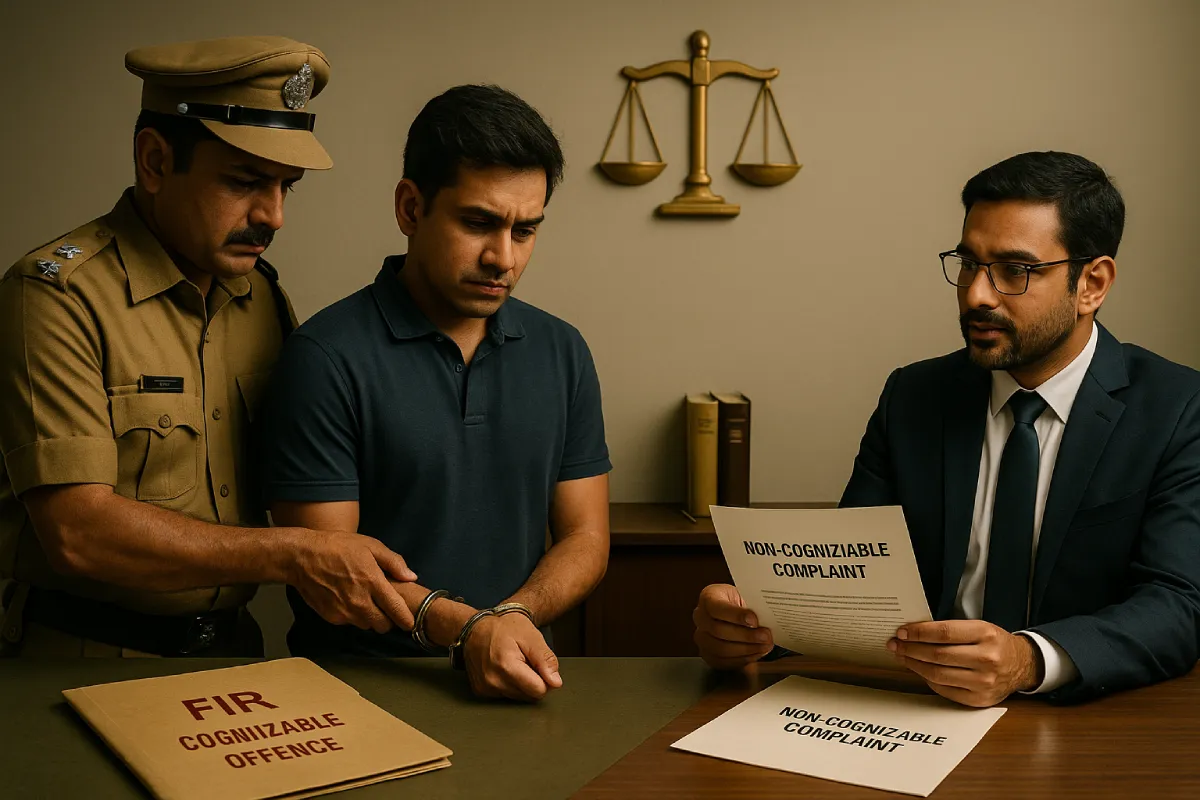
Cognizable vs Non-Cognizable Offences Under BNSS

All offences are crimes,
but not all crimes are offences under Indian law.
The BNSS classifies offences as cognizable or non-cognizable through the First Schedule and applicable special law. The classification determines, among other things, whether police may arrest without warrant and investigate without a Magistrate’s order. This guide should be read with the official BNSS text and First Schedule.
What are cognizable and non-cognizable offences?
Ask ChatGPT
Cognizable offences are crimes where the police can arrest the accused without a warrant and start an investigation without prior approval from a magistrate. These are generally more serious offenses, such as murder, rape, robbery, or grievous assault.
For a non-cognizable offence, police generally cannot arrest without warrant and cannot investigate without the order of a Magistrate under Section 174 BNSS. The classification must be checked against the schedule for the specific offence; broad examples can be misleading.
Importance of cognizable and non-cognizable offences in fir registration
For information disclosing a cognizable offence, Section 173 BNSS governs recording of the information. For a non-cognizable offence, Section 174 provides for entry of the substance, referral to the Magistrate and the restriction on investigation without the Magistrate’s order.
A COMPARISON OF BOTH COGNIZABLE AND NON-COGNIZABLE OFFENCE
CRIMINAL LAW AND POLICE FIR PROCESS
Criminal law in India works hand-in-hand with the FIR registration process to determine the seriousness of the case. The distinction between cognizable and non-cognizable offenses directly affects the course of action:
- In cases of cognizable offenses, once the FIR is filed, police can arrest the accused, gather evidence, and begin investigations promptly.
- In cases of non-cognizable offenses, the police have limited powers and need the court’s permission to proceed with an investigation. This often means more steps are involved in the legal process, and the outcome may take longer.
WHAT TO DO IF POLICE REFUSE TO REGISTER AN FIR?
If the information discloses a cognizable offence and the officer in charge refuses to record it, follow the escalation route in Section 173(4) BNSS. A non-cognizable report follows the separate Section 174 procedure.
- Approach a Senior Officer: If the police station refuses to register an FIR for a cognizable offense, you can escalate the matter to a senior officer or the Superintendent of Police.
- Apply to the Magistrate after the statutory escalation: Section 173(4) BNSS provides for a written report to the Superintendent of Police. If that does not result in action, Section 175(3) permits an affidavit-supported application to the Magistrate, who may order investigation after the statutory consideration.
REAL-TIME EXAMPLES AND PUNISHMENTS FOR COGNIZABLE OFFENCES
1) Murder: Section 101 BNS defines murder; punishment is provided by Section 103 BNS. Whether a homicide amounts to murder depends on the statutory ingredients, exceptions and evidence. The BNSS First Schedule classifies the offence as cognizable and non-bailable.
Punishment: Section 103 of BNS provides for the punishment, Life imprisonment or death penalty (depending on the case)
Primary source: Check Sections 101 and 103 of the Bharatiya Nyaya Sanhita, 2023 and the BNSS First Schedule rather than relying on a generic sentencing statement.
2) Rape (IPC Section 375, BNS Section 63): Rape is a cognisable offence considered one of the most serious crimes against women in India.
Punishment: Rape is punishable with rigorous imprisonment for a minimum term of seven years which can extend to life imprisonment. In cases of gang rape or where the victim is under 12 years of age, the punishment can be much harsher.
Case Law: In the famous Nirbhaya case (2012), the Delhi gang rape, the convicts were sentenced to death after being found guilty of rape and other associated crimes.
3) Theft: Section 303 BNS defines theft and provides graded punishments. Classification and punishment should be checked against the precise clause and the BNSS First Schedule.
Punishment: Imprisonment for a term that may extend to three years, or a fine, or both.
Case Law: In K. M. Nanavati v. State of Maharashtra (1962), the Supreme Court ruled that in cases of theft, the intent behind the act plays a crucial role in determining the seriousness of the offence and the corresponding punishment.
4) Kidnapping: (IPC Section 363, BNS Section 137): Kidnapping for ransom or for other reasons is also a cognizable offence.
Punishment: Imprisonment for a term of up to seven years or a fine, or both.
Case Law: In Kishore Kumar v. State of Haryana (2003), the accused was sentenced to rigorous imprisonment after being convicted for kidnapping a child. The case highlighted the importance of swift police action in kidnapping cases.
REAL-TIME EXAMPLES AND PUNISHMENTS FOR NON-COGNIZABLE OFFENCES
1) Defamation: (IPC Section 499, BNS Section 356): Defamation is where a person’s reputation is harmed through false statements. This offence can either be civil or criminal, but to arrest someone under this offence, the police need a warrant.
Punishment: Imprisonment for up to two years, or a fine, or both.
Case Law: The Supreme Court upheld the validity of criminal defamation law under Section 499, stating that defamation is an offense against an individual’s dignity and social reputation in the case of Subramanian Swamy v. Union of India (2016).
2) Simple Assault: (IPC Section 352, BNS Section 130): Simple assault or hurt is physically hurting someone, but it does not lead to serious injury or death.
Punishment: Imprisonment for up to three months, or a fine of up to ₹500, or both.
Classification warning: The legal classification depends on the precise BNS provision and First Schedule entry. A generic label such as “simple assault” is not enough to determine whether police may arrest without warrant or investigate without a Magistrate’s order.
3) Mischief: (IPC Section 425, BNS Section 324): Mischief involves causing intentional damage or loss to property or diminishes the valuation of the property
Punishment: Imprisonment for up to one year, or a fine, or both.
Case Law: In K.K. Verma v. State of UP (2003), the court elaborated on how mischief charges are minor but can lead to more severe consequences in cases involving public property or national security.
WHEN SHOULD YOU CONSULT A CRIMINAL LAWYER?
Consulting a lawyer can be incredibly helpful in case of uncertainty to identify whether the case involves a cognizable or non-cognizable offence or when facing an issue which could fall under the category of non-cognizable offence that you do not know, the lawyers provide legal advice on the right steps to take and ensure that your rights are protected throughout the legal process.
So, the next time you come across any such offences, you know what to do. Be it filing an FIR for a cognizable offence or dealing with a non-cognizable offence, seeking professional legal advice from an experienced criminal lawyer can help ensure that your case is handled right and fair.

