
Can a Husband Claim Maintenance? The Real Law

When a marriage breaks down, the financial strain often hits as hard as the emotional pain. You may be dealing with separation, legal fees, social stigma, and the stress of living apart without stable support. In that situation, one question comes up quickly: Can a Husband Claim Maintenance from his wife in India?
The direct answer is yes, but only in specific situations. Indian law does not give every husband an automatic right to maintenance. A husband can seek maintenance if the law governing the marriage allows it and if he can show that he does not have sufficient independent income to support himself or meet litigation costs. In many Hindu matrimonial disputes, this claim can be made under the Hindu Marriage Act, 1955. But under other laws, including the summary criminal maintenance route now found in the Bharatiya Nagarik Suraksha Sanhita, 2023, the remedy is still framed for wives, children, and parents, not husbands.
This guide will walk you through your legal rights, the laws that matter, the practical steps you should take, and the remedies that may be available if you are in Bengaluru or elsewhere in India.
Can a Husband Claim Maintenance in India?
A husband can claim maintenance in India, but the answer depends on the law under which the case is filed and the facts he can prove.
If your marriage dispute is being dealt with under the Hindu Marriage Act, 1955, Sections 24 and 25 are the key provisions. Section 24 allows either the wife or the husband to seek interim maintenance and litigation expenses during a pending matrimonial case. Section 25 allows either spouse to seek permanent alimony or maintenance at the time of the decree or even later.
That said, courts do not treat this as a routine claim. Husband claiming maintenance succeeds only when the facts show genuine financial dependence, not a simple refusal to work. Maintenance cases in favour of the husband do exist, but courts usually examine them closely and expect clear proof.
Which laws allow a husband to seek maintenance, and which do not?
The legal provision matters as much as the financial facts. Many people assume all maintenance laws are gender neutral. That is not correct.
This quick comparison helps. Not every maintenance law gives the husband the same remedy.
|
Law |
Who can apply |
What it covers |
Practical point |
|---|---|---|---|
|
Husband or wife |
Interim maintenance, litigation expenses, and permanent alimony |
Most relevant route for husbands in Hindu matrimonial cases |
|
|
Wife, children, parents |
Summary maintenance remedy |
A husband cannot normally claim maintenance here |
|
|
Wife |
Maintenance during a subsisting Hindu marriage |
Not a husband’s remedy |
|
|
Wife |
Interim and permanent alimony |
Generally structured in favour of the wife |
|
|
Wife |
Alimony in Christian matrimonial matters |
Not generally a husband’s route |
|
|
Husband or wife |
Interim and permanent maintenance |
Can be used by either spouse in the right case |
What this means in practice is simple. If you are a Hindu husband and a matrimonial case is pending, the Hindu Marriage Act is usually the strongest basis for a maintenance claim. If you use the wrong provision, the case can fail before the court even reaches the question of financial need.
When do courts seriously consider a husband claiming maintenance?
Courts look for real financial dependence. A husband does not get maintenance just because the wife earns more.
The court usually examines questions like these:
- Do you have any independent income that is sufficient for your support?
- Are you unemployed because of genuine circumstances, or are you simply not working?
- Do you have a medical condition, disability, caregiving burden, or other reason affecting your earning capacity?
- What is your wife’s actual income, and can it be proved?
- What was the standard of living during the marriage?
- What are the liabilities of both parties, including rent, loans, medical costs, and children’s expenses?
- What is the conduct of both parties, especially in a claim for permanent alimony?
This is where many claims become weak. A simple statement that you are not earning is rarely enough. Courts usually want documents, bank records, income details, medical papers if relevant, and a believable explanation of why support is needed.
In practice, an able-bodied and qualified husband may face a tougher standard. If the court feels he is choosing not to work despite having the ability to earn, relief may be reduced or refused. But where the facts show genuine hardship, illness, unstable work, or a serious income gap, the court can grant support.
Interim maintenance and permanent alimony are different remedies
Temporary support during the case and long-term support after the decree are not the same. The purpose, timing, and legal standard are different.
Interim maintenance during the case
This is short-term support while the matrimonial case is pending. It can include:
- Monthly maintenance during the proceedings
- Litigation expenses
- Financial support so that one spouse is not crushed during the case
For a husband, this usually comes through Section 24 of the Hindu Marriage Act if the marriage is governed by that Act. The court compares the incomes of both sides and decides what is reasonable.
Permanent alimony after decree
This is considered when the court passes a decree of divorce, judicial separation, nullity, or related relief. Under Section 25 of the Hindu Marriage Act, the court can award a lump sum or periodic payment after considering income, property, conduct, and the surrounding facts.
So yes, a husband may seek support during the case and, in the right case, even after the decree. But both remedies depend on evidence, fairness, and the law that applies.
What evidence helps in maintenance cases in favour of the husband?
Maintenance cases are decided on proof, not sympathy alone. Strong documents often matter more than emotional allegations.
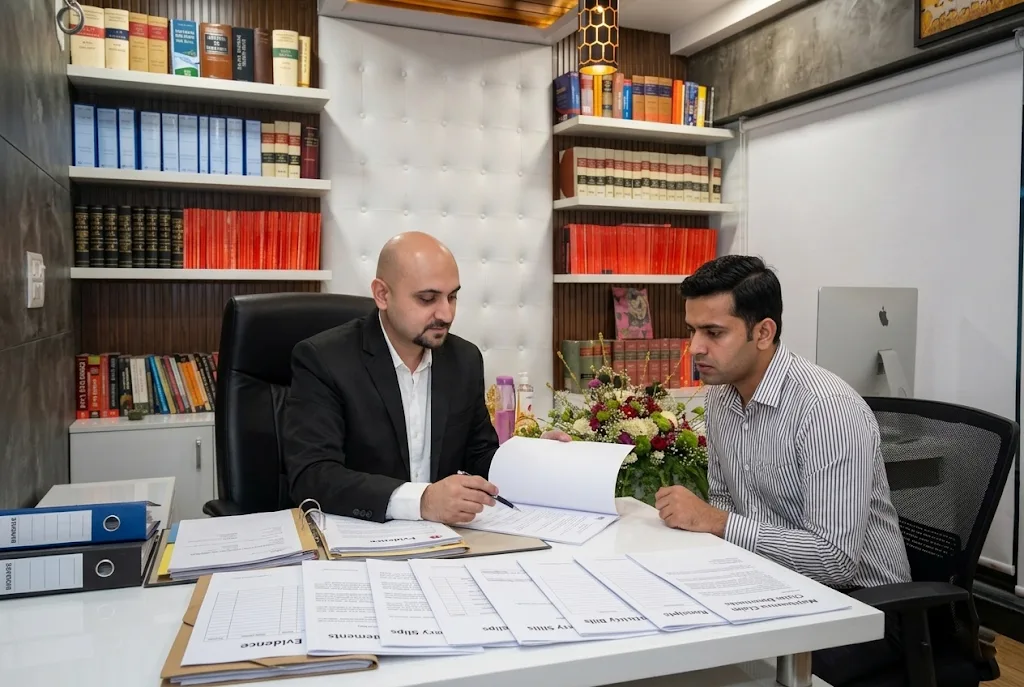
Useful material may include:
- Marriage certificate or other proof of marriage
- Copy of the pending divorce, restitution, or judicial separation case
- Your bank statements
- Your income tax returns, salary records, or proof of no income
- Termination letter, medical records, disability records, or business loss documents
- Your wife’s salary slips, company details, bank entries, or other proof of income if available
- Rent agreement, EMIs, school fees, medical expenses, and household bills
- Proof showing attempts to find work, if unemployment is temporary
The Supreme Court has also emphasised full financial disclosure in maintenance matters, especially in Rajnesh v. Neha. In real litigation, both sides should be ready with proper asset and income details, not vague estimates. If you are still putting your papers together, this financial and emotional guide to preparing for divorce in India can help you organise the basics before you file.
Practical steps if you are facing this issue
A careful first move can save months of damage. If you think you may be entitled to maintenance, act methodically and do not wait for the financial pressure to become worse.
|
Step |
What you should do |
Why it matters |
|---|---|---|
|
1 |
Identify the law governing your marriage and the pending case |
Your remedy depends on the correct statute |
|
2 |
Gather income, expense, and asset documents for both sides |
Maintenance turns on evidence |
|
3 |
Record the reason for unemployment or low income clearly |
Courts look at earning capacity, not just present income |
|
4 |
Prepare a full financial disclosure with supporting papers |
Incomplete disclosure weakens credibility |
|
5 |
File the application early in the pending matrimonial case |
Delay can hurt your position |
|
6 |
Ask for litigation expenses if needed |
Many applicants forget this part |
|
7 |
Stay consistent in pleadings, affidavits, and oral statements |
Contradictions can damage the case badly |
In Bengaluru, these issues are usually dealt with before the Family Court, depending on the facts of jurisdiction and where the matrimonial case is pending. If the main matrimonial proceeding has not yet been filed, our guide on how to file for divorce in Bangalore explains the usual process, forum, and paperwork. It also helps to understand whether your matter is likely to proceed as a contested or uncontested divorce, because that affects timing, negotiation, and the way maintenance issues are usually argued. A rushed application can make a valid claim look weak, so drafting and documents matter a lot.
A few realities that many husbands do not expect
Maintenance law is not only about gender. It is also about credibility, fairness, and timing.
Some practical realities are worth keeping in mind:
- The court may reject informal cash-income claims if there is no proof.
- Hidden earnings, business receipts, or unexplained spending can damage your case.
- If both spouses earn, the court will still compare who is financially stronger and who actually needs support.
- Maintenance can be increased, reduced, or cancelled if circumstances change.
- In suitable cases, relief may be awarded from the date of application and not only from the date of the order.
- Filing overlapping maintenance proceedings without proper disclosure can create serious complications.
It also helps to separate myth from law. For example, a spouse does not automatically get half of the other spouse’s net worth as alimony. In many families, maintenance disputes are also resolved through divorce mediation, especially where both sides want a practical settlement instead of a longer courtroom fight.
This is why legal strategy matters. The strongest case is usually the one that is factually clean, financially documented, and filed under the right provision from the start.
Why expert legal counsel from Kapil Dixit LLP matters in these cases
Early legal advice prevents expensive mistakes. In maintenance disputes, one wrong pleading, one missing income document, or one incorrect legal provision can shape the whole case.
At Kapil Dixit LLP’s divorce law team in Bangalore, we assist clients in Bengaluru and across Karnataka with practical support in divorce law and family law matters. That includes:
- Reviewing your facts and documents carefully
- Assessing whether your claim is legally sustainable
- Identifying the correct forum and legal route
- Drafting petitions, replies, affidavits, and disclosure papers
- Representing clients in Family Court proceedings
- Negotiating workable settlements where possible
These disputes are emotionally draining. You need legal advice that is clear, realistic, and rooted in how family law actually works in court.
FAQs about whether a husband can claim maintenance from his wife in India
Can an unemployed husband claim maintenance from a working wife in India?
Yes, he can, but unemployment alone is not enough. The court will ask whether he genuinely lacks sufficient independent income and whether the wife has the financial ability to support him. If he is healthy, qualified, and simply avoiding work, the court may refuse relief. Good documents make a major difference.
Can a working husband still ask for maintenance?
Sometimes, yes. The real issue is not whether he earns something, but whether that income is sufficient for his support and litigation costs. If his income is modest and the wife is in a much stronger financial position, the court may still consider relief. The outcome depends on actual earnings, expenses, and fairness.
Can a husband claim maintenance under Section 144 of the BNSS?
No, not ordinarily. Section 144 of the Bharatiya Nagarik Suraksha Sanhita is framed for wives, children, and parents. A husband seeking maintenance usually has to rely on the correct personal law provision, such as Sections 24 and 25 of the Hindu Marriage Act, in a suitable case.
Can a husband get maintenance after divorce, or only during the case?
He may be able to seek both, depending on the law that applies. Under the Hindu Marriage Act, interim maintenance can be sought during the proceedings under Section 24, and permanent alimony may be claimed under Section 25 at the time of the decree or later. The court will still examine financial need, conduct, and the overall circumstances.
Will the court look at the wife’s salary and assets?
Yes. Maintenance decisions depend heavily on financial disclosure. Salary, business income, rental income, investments, liabilities, and lifestyle evidence may all become relevant. If one side hides income, the court can draw adverse conclusions.
Do maintenance cases in favour of the husband happen often?
They are less common than maintenance orders in favour of wives, but they do happen. Courts are willing to grant relief when the law allows it and the husband shows genuine financial dependence. The key is evidence, not assumption.
Can a maintenance order be changed later?
Yes. If income changes, a party gets a new job, liabilities increase, remarriage becomes relevant under the applicable law, or other circumstances shift materially, the court can modify the order. One maintenance order does not always stay fixed forever.
Where should a husband in Bengaluru file this application?
Usually, the application is filed in the same matrimonial case before the Family Court dealing with the divorce, judicial separation, or related petition. Jurisdiction depends on the facts, including where the parties lived, where the case is pending, and the law under which proceedings have been filed. A local legal review before filing is always wise.
Conclusion
Marital breakdown is never only a legal problem. It brings stress, confusion, financial pressure, and a lot of wrong assumptions about what the law really allows. If you are asking whether you have any remedy, the answer is that the law does provide one in the right case.
Can a Husband Claim Maintenance? Yes, in India, he can, but not under every law and not without proof. The strongest claims usually arise under the Hindu Marriage Act or other spouse-neutral provisions, backed by clear evidence of financial need and the wife’s ability to pay.
If you are facing this issue in Bengaluru, Karnataka, do not delay because of fear, stigma, or confusion. Early legal advice can help you choose the right provision, protect your position, and avoid costly mistakes.
Contact Kapil Dixit LLP for a confidential consultation, whether you prefer an in-person meeting in Bengaluru or an online lawyer consultation.
Disclaimer: This article is for general information only and is not specific legal advice.

